
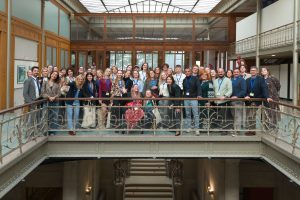
Photo credit: @ Missing Children Europe, 2026, taken by Alain Sannen
How does the You Decide final conference put displaced Ukrainian youth voices, experiences, and futures at the centre of research and policymaking?
What does it mean to build a future when so much remains uncertain? For young Ukrainians, this is not an abstract question. It shapes decisions about education, employment, where to live and how to imagine adulthood.
On 15 October 2026, The Heartwarming’s team joined Missing Children Europe and the YoU Decide consortium partners for the final conference, Moving Beyond Uncertainty: Displaced Youth of Ukraine Transitioning to Adulthood in Europe.
Opening the conversation
Aagje Ieven, Secretary-General of Missing Children Europe, opened the conference with welcoming remarks, followed by a keynote address from Denys Uliutin, Ukraine’s Minister of Social Policy, Family and Unity.
These opening contributions set the scene for a day dedicated to understanding the realities facing displaced Ukrainian youth and considering how European and Ukrainian institutions can work towards more sustainable solutions.
From the very beginning, youth voices were at the centre of the conversation.
Co-Researching with young people – and learning with and from them
Heartwarming’s team, Lina Vosylute, Dr Jennifer Allsopp and Helena Wacko, along with Diana Hubaidulina, Ruslan Binazorov, and Herman Barushkov, presented the Research Report – Reclaiming Our Voice findings. This session focused on understanding the realities of Young People Transitioning into Adulthood in Displacement. Helena Wacko, when presenting the research, stressed the role of hobbies, participation, and citizenship that emerged through the co-creative methodology, as additions to the ‘life projects’ model.
Lina Vosyliute further explained how the Heartwarmingly research team, with the project partners, operationalised the trauma-informed, participatory, youth-led research design. She shared YoU Decide co-produced Ethical and Participatory Research Guidelines that include the background research, tips and templates on, for instance, how to ethically go about anonymous surveys with displaced young people, and how young people could be empowered to be at the forefront of the research design, such as co-facilitators of the focus groups, vetting the questions or strategising about youth-relevant dissemination channels.
Dr Jennifer Allsopp has also had lively conversations with YoU Decide Youth Advisory Board members Diana Hubaidulina, Ruslan Binazorov, and Herman Barushkov. She asked about their experience participating in the research and how it impacted them personally. The discussion highlighted the value of co-creative research, where young people actively shape the research process and contribute as co-researchers and co-facilitators, and how, in fact, it was fun and empowering for young people and very important for the research – to keep a set of open questions in the survey.
The discussion created an opportunity for direct exchange between the research team, young Ukrainians, and key Ukrainian policymakers, such as Denys Uliutin, Ukraine’s Minister of Social Policy, Family and Unity, and Ilona Havronska, Ukraine’s Deputy Minister of Social Policy, Family and Unity for European Integration. This discussion highlighted the importance of involving young people with lived experience in shaping policies and support systems, not only for them, but with them. They called for policymakers to create conditions of certainty and agency so young people can make choices freely. This also
As displaced young people grow into adulthood, they need more than immediate assistance. They need accessible information, educational opportunities, pathways into employment, and support systems that help them build independent lives, including hobbies, finding friends, and ways to express their voice through civic and youth activities with Ukrainian youth and also with other young people.
Young people navigating a new country and an uncertain future also need accessible housing and health services that take their situation, language, and age into account. Most importantly, as they also later stressed, they need certainty about residence rights and coordinated support from both the EU and Ukraine that responds to their circumstances.
The challenge is not simply to help today, but to create the long-term conditions for young people to flourish and thrive so they can contribute to the future of Europe and Ukraine later.
Practitioners Panel: Creating Support Systems that Enable Young People to Thrive
The conference then turned to practical experiences during the practitioners’ panel, Creating Support Systems that Enable Young People to Thrive, facilitated by Laszlo Fejos from Terre des hommes Hungary. Lazslo asked how to scale, adapt, and strengthen current initiatives to support better displaced Ukrainian youth across Europe?
The first part focused on building on what works. Roman Makukha (ICMPD) presented lessons learned from Unity Hubs and Ukrainian Consultation Centres across Europe, while Olsi Dudumi (Terre des hommes Lausanne) introduced Resilience Innovation Facilities (RIF) in Hungary, Romania and Ukraine. Andrea Tedde (Missing Children Europe) then discussed Miniila website, a digital information tool designed to scale across countries and adapt to young people’s information needs. You Decide project contributed to the further development of Minilla.
We also contributed to the development of Minilla. Heartwarmingly research team asked Youth Advisorty Board and other displaced Ukrainian youth about what type of support and information they missed the most and why. YoU Decide partners listened. They equipped Minilla with the relevant and accessible information. Our research and youth testimonies also proved, thatwhen delivered in a timely, youth-friendly way – these services can be life-changing or even life-saving.
Part II
Support Services and Programmes for Displaced Youth from Ukraine: Lessons Learned and Future Directions
It shifted the focus towards practical services and programmes supporting young people’s education, employment and well-being.
Through brief, pitch-format presentations, speakers shared their initiatives and experiences.
Mariya Boguslav, coordinator of the EduHub Network at the Association of Innovative and Digital Education (AIDE), presented the StepToJob project and its employment pathways for young people.
Iryna Garvanko and Daria Iakovenko from the Child Helpline at Børns Vilkår discussed the innovative use of AI to translate incoming messages from Ukrainian children and youth, so their Danish colleagues could also provide timely assistance. Through these messages, they highlighted experiences of Ukrainian pupils and students in Danish schools and universities facing linguistic challenges and, as a result, failing exams in their ‘Between Two Worlds’ report.
Peter Bennet introduced Youth for Unity and Play4Unity, an engaging youth space where Ukrainian and local youth meet. He also acknowledged the need for Ukrainian-youth-only spaces.
Olena Sakovych, UNICEF Programme Coordinator, presented the PATHWAYS initiative, which focuses on education and career support for Ukrainian youth and adults. While the programme developed valuable methodologies with national partners, it is currently being rolled out only in Ukraine.
Finally, Elisa Pothee from Kids in Need of Defence (KIND) Europe highlighted the need for holistic support for young Ukrainians on the move.
The session extended beyond presentations. Following the short pitches, participants continued their discussions in a World Café format, creating opportunities to exchange experiences, reflect on lessons learned and explore future directions together. However, short-term, project-based and shrinking EU funding for activities with Ukrainian youth has also been mentioned by many as a common challenge.
Members of the YoU Decide Youth Advisory Board: Ruslan Binazarov, Herman Barushkov, Diana Hubaidulina, Polina Sukach, Nastasiya Krapivkina, David Prohonnyi, Timur Zdan-Marchiev and Viktoriia Romanova shared their experiences of building a future across borders while navigating uncertainty. This pannel showcased why giving young people shall be given a meaningful role in decisions that affect their lives, as they are the experts of their realities. They are students (of different fields from chemistry to car mechanics), artists, community members, starting entrepreneurs and professionals, and future leaders who need to make important life choices now.
Their discussion challenged the assumption that uncertainty about the future is inevitable. As the Youth Advisory Board member explained: “There is a difference between not knowing what your future will look like and not knowing what options are available”. The Youth Advisory Board thus called on the EU and Ukrainian policymakers: “Give us Enough Certainty”. They laid out concrete steps to get there.
The Youth Advisory Board Members rejected the idea that integrating into European societies requires sacrificing their Ukrainian identity to be European, as ‘ Being Ukrainian is Being European’. Youth were emphasising that belonging can extend across multiple places and that living abroad does not preclude supporting Ukraine’s recovery. They stressed that, if supported today to navigate their transitions into adulthood better, they will be better placed to contribute to Ukraine’s recovery. They also extended the message of human compassion and human rights towards everyone needing to flee their country – to be welcomed with dignity, hospitality and kindness. In their personal testimonies, young people repeatedly stressed ‘being lucky’ or ‘being grateful’ to people, NGOs, and government services that supported them during the most challenging times and helped them navigate the legal and administrative maze.
Policy Panel: Moving Beyond Temporariness: Building Sustainable Futures for Young People Displaced from Ukraine.
The afternoon panel focused on how to Move Beyond Temporariness. This discussion , mooderated by Alyona Samar from Missing Children Europe brought together representatives of the European Commission, Isabela Atanasiu, Legal Officer, DG HOME; Ukraine’s Deputy Minister of Social Policy, Family and Unity for European Integration, Ilona Havronska; and Angela Moore, UNHCR, Head of the Policy and Legal Support Unit, Representation for EU Affairs. They examined the future of temporary protection and the need for safe and predictable pathways into adulthood.
Deputy Minister Ilona Havronska highlighted the importance of recognising that temporary protection should only halt when the war is over. Even as their future remains uncertain, young people continue to make important decisions about education, employment, and where to build their lives.
Young people need continuity of support, clear information and realistic opportunities to make informed life-changing decisions. European and Ukrainian institutions therefore have an important role in developing approaches that recognise the complexity of young people’s circumstances and aspirations.
Conclusion
The YoU Decide final conference marked the culmination of a wholehearted and collaborative journey. Still, its message extends beyond the project partners and participants. It resonates with a wider community of practitioners in displacement, human rights, child- and youth-friendly inclusion and integration processes, and trauma-informed, participatory, and youth-led researcher up-takers.
Young people displaced by war should not have to wait for uncertainty to disappear before they can begin building their futures. They need opportunities to learn, work, participate, and make decisions about their lives today.
Bringing together youth, policymakers, researchers, and practitioners created space for genuine dialogue beyond formal presentations. Youth Advisory Board members built skills, expanded personal networks and friendships, and shaped discussions that affect their lives. YoU Decide Youth Advisory Board urged organisations and researchers to keep engaging young people and listening to their experiences. The current challenge is translating these insights into concrete action: clearer information, accessible opportunities, reliable support, and tailored policies. These recommendations provide a strong framework for ongoing collaboration between European and Ukrainian stakeholders, centred on youth lived experiences, and expanding their choices.
We also celebrated the connections, care, trust, perseverance, and hope narrated throughout the YoU Decide project. We celebrate and remain deeply grateful for Alyona Samar coordinated this EU-funded project from Missing Children Europe with committed local partners – Terre des hommes – Hungary, Fundacja ITAKA – Centrum Poszukiwań Ludzi Zaginionych, and Organizace pro pomoc uprchlíkům, z.s.Their commitment and collaboration made this exchange possible and reinforced the importance of placing young voices at the heart of decisions affecting their futures.
Related Links:
YoU Decide – Missing Children Europe
YoU Decide Research Report – Reclaiming Our Voice
YoU Decide Guidance and Good Practice Toolkit – Missing Children Europe
Conclusions from YoU Decide Final Conference – Missing Children Europe


